


What’s New in the Updated Food Pyramid
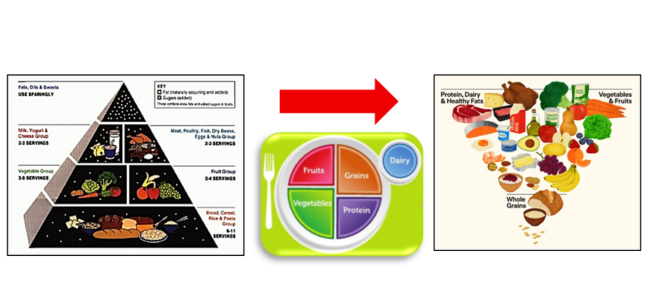
New US Dietary guidelines were released last week from the Department of Health and Human Services (HHS). Below, the illustration of the “old” food pyramid, in use from 2005-2011, encouraged a base of grains, equal parts fruits and vegetables, smaller portions of dairy and proteins (including meat, poultry, and fish), and a minimum amount of fats and oils.
From 2011-2025, the recommendations were represented in a different shape: a circle. “My Plate” encouraged produce (fruits and vegetables) to comprise about half the daily intake, with equal parts grains and proteins, and a side serving of dairy. This year’s update is once again illustrated by a triangle, but flipped on its head. While the grains are still at the bottom of the picture, it is now advocated that they make up the smallest food group. Produce stays in the middle (in both pyramids and on the plate, these comprise roughly half of the suggested daily intake), and “healthy fats”, oils, and fleshy proteins are encouraged in larger quantities than previously advocated.
The American Heart Association (AHA) did not automatically echo these recommendations. There is some concern that high volumes of red meat can overload the system with salt and saturated fats, major drivers of heart disease. They recommend instead to prioritize plant-based proteins, seafood, and lean meats. The new pyramid also suggests whole-fat dairy, and the AHA prefers heart-healthy low-fat and fat-free dairy products. The AHA did praise the new guidelines’ limitation of added sugars, refined grains, highly processed foods, and sugary drinks.
Ultra-processed foods are singled out in the new pyramid, with advice to “avoid highly processed packaged, prepared, ready-to-eat, or other foods that are salty or sweet, such as chips, cookies, and candy that have added sugars and sodium.” The advice further encourages eating home-cooked meals over dining out.
The government-backed guidance from the HHS will shape Women, Infants, and Children (WIC) benefits, school lunch parameters, and Supplemental Nutrition Assistance Program (SNAP) subsidies.